
Roof Condition Reports: Written, Documented, Defensible.
Roof Condition Reports: Written, Documented, Defensible support in New Orleans, LA, with documented inspections, written scopes, and practical roof planning for commercial properties.
What this roof work solves
Roof Condition Reports: Written, Documented, Defensible in New Orleans should begin with a documented roof walk. The first job is to identify active water entry, drainage problems, membrane condition, edge details, rooftop equipment conflicts, and weather exposure before a price or schedule is discussed.
For commercial owners, the useful answer is rarely a one-line recommendation. The roof file should explain the work area, the reason for the scope, the access constraints, and the next maintenance decision.
How the scope is built
The scope is based on service scope, building use, roof age, visible defects, and the cost difference between immediate repair and longer-range planning. When repair is enough, the work stays focused. When replacement or recover planning is the responsible move, the reasoning is written plainly.
Each finished project should leave behind before-and-after photos, service notes, and follow-up items so the owner keeps a record for future inspections, budgeting, and vendor conversations.
A roof condition report for a New Orleans commercial building needs to tell the reader what it found, and it needs to hold up against the next storm season, the next insurance claim, and the next ownership transfer. We produce three report depth tiers matched to what the owner, lender, buyer, or insurer actually needs from the report.
The most common request we receive from New Orleans commercial real estate attorneys, property managers, and ownership groups is for a roof condition report that is actually useful, not a one-page checklist or a brief email summary. A useful condition report in this market tells the reader what system is on the roof, when it was installed, what storm events it has been through, what condition it is in across every zone of the building, what repairs or actions are needed and in what timeframe, and what the roof's remaining useful life estimate is. In a market with documented hurricane history, that storm-exposure context belongs in the report.
We produce condition reports in three depth tiers. The basic tier serves single-building inspections needed for insurance renewal, quick asset review, or facility manager documentation. The comprehensive tier covers asset sale due diligence, insurance claims, or any situation where the report will be reviewed by a party other than the building owner. The capital-grade tier covers institutional lenders, CMBS portfolio reviews, and situations where the report's methodology and defensibility matter as much as the findings.
Every tier shares the same physical inspection foundation: a documented roof walk with a zone diagram, photo log, and condition rating scale applied consistently across every finding. What differs between tiers is the depth of the written narrative, the scope of historical documentation, the capital horizon analysis, and the detail and certification level of the scope section.
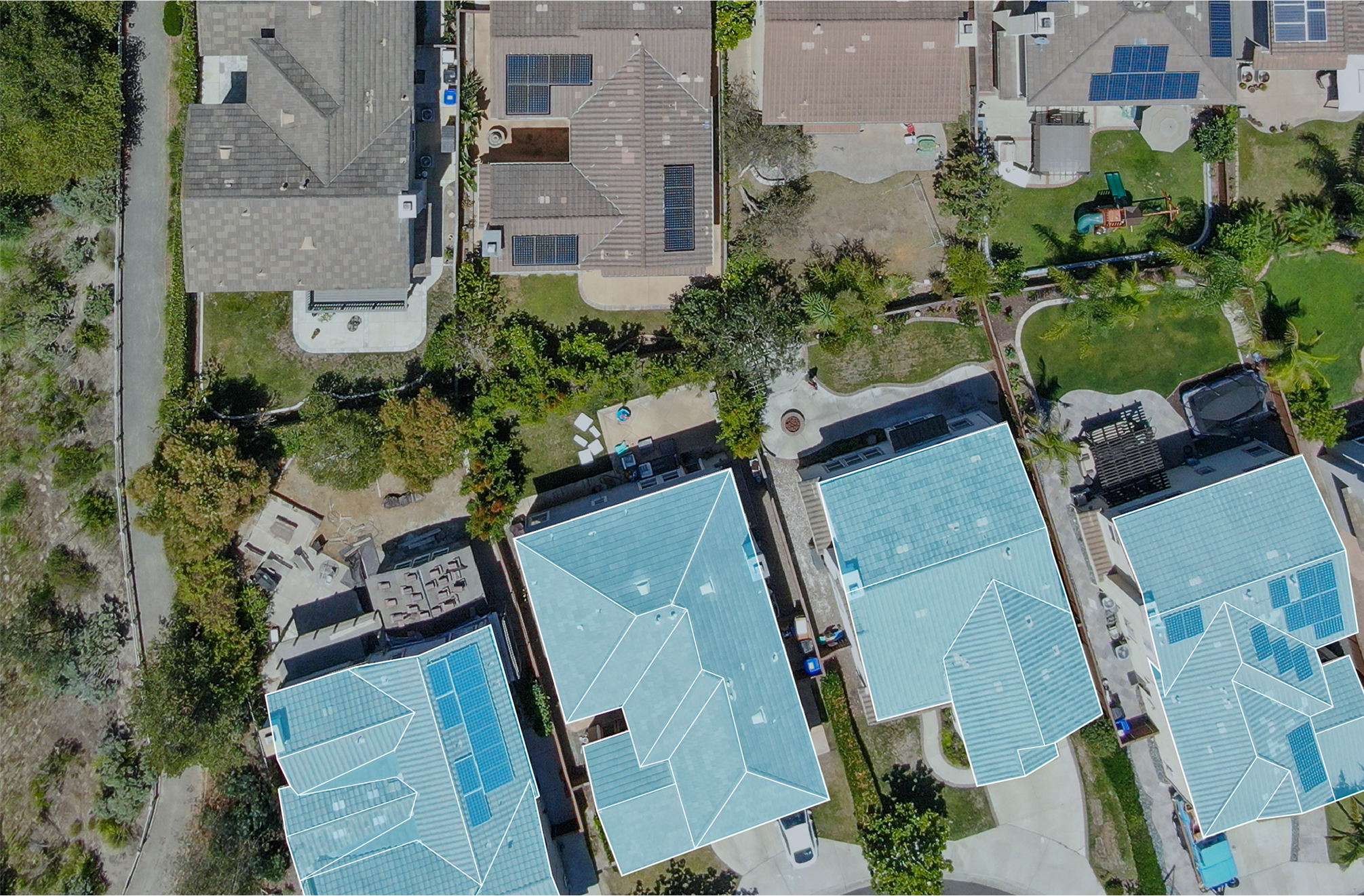
Zone diagram: a to-scale plan drawing of the roof divided into inspection zones, with all drains, penetrations, rooftop equipment, parapets, scuppers, and access points marked. Every finding and every photograph is keyed to its location on the zone diagram. We produce the zone diagram during the inspection from field measurements and refine it against satellite imagery before the report is delivered, so the reader can orient every condition finding spatially without having been on the roof.
Photo log: every material finding is photographed with a wide-shot framing to establish the zone location and a close-up to show the specific deficiency or condition detail. Photos are labeled with the zone diagram reference and the finding description. Embedded GPS coordinates and timestamps are included on every photo. A comprehensive condition report on a 50,000 sq ft New Orleans office building produces 80-120 photos; a basic inspection produces 30-50.
Scope columns: findings are organized into three action columns; Immediate (repair within 30 days to prevent active water infiltration or warranty compromise), Near-Term (repair within 90 days to prevent deterioration), and Capital (replacement planning within 1-5 years). This structure gives the owner and any third-party reader a triage view without requiring them to read the full narrative. For New Orleans buildings, we also include a Storm Vulnerability notation for any finding that represents elevated risk during a tropical weather event: this notation goes beyond the standard triage columns and is specific to the Gulf Coast market.
Basic condition report: physical inspection, zone diagram, photo log, 1-2 page written summary, and scope columns. Turnaround 3-5 business days after the site visit. Appropriate for insurance renewal documentation, quick asset review, internal facility manager record-keeping, and pre-lease roof disclosure. Not formatted or certified at the level institutional lenders or due diligence teams require.
Comprehensive condition report: everything in the basic tier plus a full written narrative covering system description and installation history, condition analysis by zone, deficiency descriptions with cause analysis and repair methodology, remaining service life estimate, and storm-exposure history section documenting which named storm events the building has experienced and what condition changes were observed following those events. 8-15 pages of written report plus photo log and zone diagram. Turnaround 7 business days. Appropriate for insurance claims, asset sale
Capital-grade report: everything in the comprehensive tier plus inspection methodology documentation, chain of custody on physical samples, historical research including permit records from the City of New Orleans Department of Safety and Permits' online permit portal and from the Louisiana Secretary of State and LDAF records for older systems, a capital replacement cost estimate prepared to a specified accuracy level, and a signed inspector certification. In the New Orleans market, the capital-grade report also includes a hurricane wind-uplift assessment documenting whether the existing attachment system meets current ASCE 7 hurricane-prone-region requirements: a significant due diligence item for any acquisition of a pre-2006 commercial building. Turnaround 10-12 business days. Used by CMBS servicers, institutional lenders, and buyers' due diligence teams.
When You Need a Condition Report in the New Orleans Market
The most common triggers for condition report requests in the New Orleans metro: commercial real estate transactions (buyer's due diligence teams want an independent roof assessment before closing on any building with storm-exposure history), insurance renewals where the carrier is requiring documented roof condition as a policy condition for wind and water coverage, post-storm insurance claim documentation where the adjuster requires technical documentation distinguishing event-related damage from pre-existing conditions, and capital planning exercises where ownership needs a third-party assessment to defend a capital replacement request.
We also produce condition reports for property management companies taking on new buildings in their portfolio. A management company that accepts responsibility for a building without a documented roof baseline inherits an undefined liability: any subsequent leak event or storm damage will be argued against an undocumented starting point. A written condition report at portfolio entry establishes that baseline and protects the property manager from being assigned responsibility for conditions they inherited.
A New Orleans-specific note on records access: the City of New Orleans permit records portal covers permits filed after 2000 with reasonable completeness. Records for buildings constructed or reroofed before 2000, or for work performed under emergency permits during the post-Katrina reconstruction period, may require in-person records requests with variable retrieval timelines. For capital-grade reports on pre-2000 buildings or on buildings reroofed between 2005 and 2008, we recommend building additional time into the schedule for records research, and we are transparent when original installation documentation cannot be located.
Questions to settle early
Where is the risk?
Locate leaks, wet-insulation indicators, open seams, weak flashing, and drainage restrictions across the roof.
What can wait?
Separate immediate work from maintenance items that can be tracked for the next service window.
What should be funded?
Build a practical recommendation for repair, coating, recover, or replacement planning.
Need help with roof condition reports: written, documented, defensible?
Send the building address, known roof age, access notes, and what changed. We will respond with the right next step.