
Solar-Ready.
Solar-Ready support in New Orleans, LA, with documented inspections, written scopes, and practical roof planning for commercial properties.
What this roof work solves
Solar-Ready in New Orleans should begin with a documented roof walk. The first job is to identify active water entry, drainage problems, membrane condition, edge details, rooftop equipment conflicts, and weather exposure before a price or schedule is discussed.
For commercial owners, the useful answer is rarely a one-line recommendation. The roof file should explain the work area, the reason for the scope, the access constraints, and the next maintenance decision.
How the scope is built
The scope is based on service scope, building use, roof age, visible defects, and the cost difference between immediate repair and longer-range planning. When repair is enough, the work stays focused. When replacement or recover planning is the responsible move, the reasoning is written plainly.
Each finished project should leave behind before-and-after photos, service notes, and follow-up items so the owner keeps a record for future inspections, budgeting, and vendor conversations.
A photovoltaic system is designed to generate for twenty to twenty-five years. The single-ply membrane under it, if it already has miles on it, may not last half that long. That mismatch is the first thing we put in front of any New Orleans property owner who calls us with a solar proposal already in hand. We are not a solar company and we do not sell panels, so the only question we answer is the one the solar bid usually skips: will the roof carry this array for the full life of the system, or are you about to bolt a twenty-year asset onto a roof with seven years left? We answer it by coring the assembly and reporting the remaining service life in writing before a single rail gets set.
The reason this matters financially is specific to how solar gets paid back. The distribution buildings off the Almonaster industrial corridor, the office towers in the Central Business District, and the big retail boxes along the I- all share the trait that makes them solar candidates: large, unshaded, low-slope roofs with thousands of square feet of clear exposure. The payback model on those arrays assumes the panels stay put and keep producing for two decades. If the membrane underneath fails in year eight, that model collapses, because someone has to pay a crew to detach the entire array, set it aside, tear off and replace the roof, and then remount everything. On a sizable system that detach-and-reset alone can run well into five figures, and it is money the original solar economics never accounted for.
Two Ways to Mount, Two Sets of Consequences
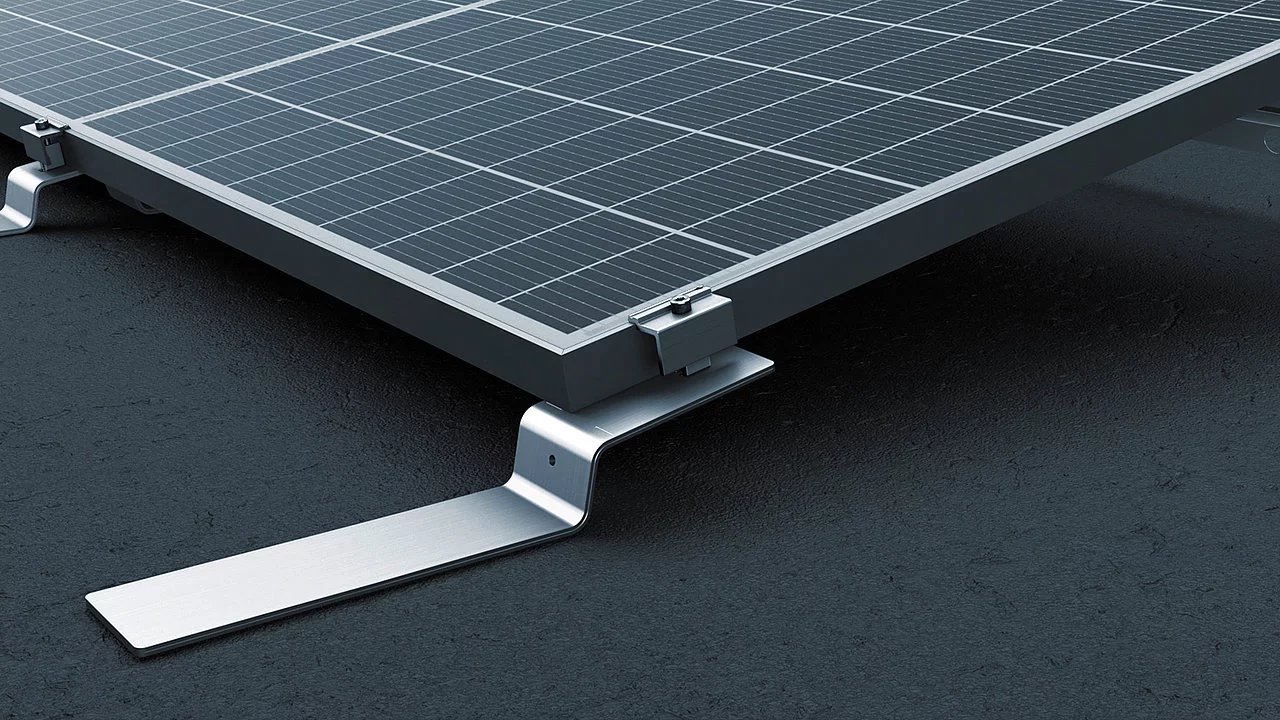
Solar gets held to a flat commercial roof one of two ways, and each one changes what happens to the membrane. A ballasted system rests on weighted trays and stays put through dead load and friction, never piercing the sheet but adding several pounds per square foot across the whole field. An attachment-mounted system bolts through the membrane and into the deck at every rack foot, and each of those feet is a penetration that has to be flashed to the exact standard we would hold a drain or a vent stack to. A mid-size array can introduce well over a hundred of these penetrations. When we get called back to a leaking solar roof in Jefferson Parish, the failure is almost always at the rack feet, where someone smeared sealant instead of building a real flashing, and it surfaces as staining over the structural bays a season or two after the system went live.
Membrane chemistry decides what is even allowed to touch the roof. Most solar going onto New Orleans commercial buildings lands on TPO or PVC single-ply, and PVC in particular will degrade if it sits against materials that leach incompatible plasticizers. That rules out using whatever slip sheets or walkway pads happen to be on the solar crew's truck. Every ballast tray, protection mat, and adhered component has to be a product the membrane manufacturer has approved for contact with that specific sheet. We also pay attention to color: a reflective white TPO or PVC surface under the panels runs cooler than a dark roof, and cooler panels produce more, which is a genuine output gain on a roof baking through a Gulf Coast summer.
Conduit Is a Roofing Detail, Not Just an Electrical One
The DC and AC runs that move power from the array to the building's electrical room have to cross the roof, and how they cross is our concern, not just the electrician's. Conduit laid flat on the membrane saws at the sheet every time the roof expands and contracts with the heat, and a conduit penetration capped with a generic boot instead of a proper through-roof flashing becomes a recurring leak. We sit down with the solar contractor before any wire is pulled, agree on the routing, set the elevated supports that keep the runs off the membrane, and build the penetration flashings ourselves. They own the conductors; we own every point where their work passes through our roof.
Weight and Uplift in a Hurricane-Coded Wind Zone
New Orleans sits in a high-wind design zone, and that reshapes the solar conversation in ways inland markets never confront. A ballasted array resists wind uplift with its own weight, but that same weight has to be carried by the structure below. On the older masonry warehouses around Central City and the Warehouse District, the original deck and framing were never sized for the dead load of a ballasted PV system plus the extra ballast it takes to hold the panels down in a tropical storm. We require a structural review of the deck and joists before we approve a ballasted layout, because the load that keeps the panels grounded in a 130-mph gust is the same load that can overstress an undersized member.
Uplift is the other half of the problem, and it is not uniform across the roof. The corners and the perimeter strip of any low-slope roof see the most violent suction in a windstorm, far more than the field. An array sitting in those zones needs either substantially more ballast or mechanical anchoring to stay put. Hurricane Ida made that lesson concrete across Orleans and Jefferson parishes in 2021, peeling equipment off rooftops in the open-terrain exposures that define so much of the metro's industrial stock. We map the perimeter and corner uplift zones on every roof and either keep the panels out of the worst pressure fields or anchor them for those loads where the layout forces them there. An array that goes airborne in a storm is a liability that dwarfs the value of the panels.
The quietest way a solar-plus-roofing project goes wrong is the warranty. A single-ply membrane carries a manufacturer's warranty that can be voided the instant a third party loads or penetrates the roof without the manufacturer signing off. Most major membrane manufacturers will keep that warranty intact over a solar install, but only on their terms: approved pads and protection, approved penetration details, and a pre-installation review by their own field representative. Skip that review, and the owner ends up holding a voided roof warranty and a solar warranty that explicitly does not cover the membrane the array is standing on.
We run that coordination as part of the job. Before the array goes up we schedule the manufacturer's field inspection, document that the racking and protection meet their published spec, and confirm the penetration details we are building match what the warranty requires. When the system is commissioned, both registrations close clean: the roof warranty survives because the install followed the rules, and the solar warranty rests on a membrane that was prepared and inspected for it. Because we have no stake in selling the panels, our only interest is a roof that lasts as long as the array and a paper trail that protects you if either system ever has to be claimed.
How a Solar Roofing Project Runs With Us
- Core sampling and a written remaining-service-life report before any solar contract is signed.
- A keep-or-reroof recommendation based on whether the membrane life matches the twenty-plus-year solar horizon.
- Structural load review for ballasted layouts, including the added ballast our wind zone demands.
- Manufacturer-approval check on every ballast tray, walkway mat, and adhered component touching the sheet.
- Pre-construction coordination with the solar contractor on conduit routing and penetration design.
- Manufacturer warranty review and field inspection before the array is loaded onto the roof.
- Roofer-built rack-foot and conduit flashings, inspected before any panels are set.
Questions to settle early
Where is the risk?
Locate leaks, wet-insulation indicators, open seams, weak flashing, and drainage restrictions across the roof.
What can wait?
Separate immediate work from maintenance items that can be tracked for the next service window.
What should be funded?
Build a practical recommendation for repair, coating, recover, or replacement planning.
Need help with solar-ready?
Send the building address, known roof age, access notes, and what changed. We will respond with the right next step.