
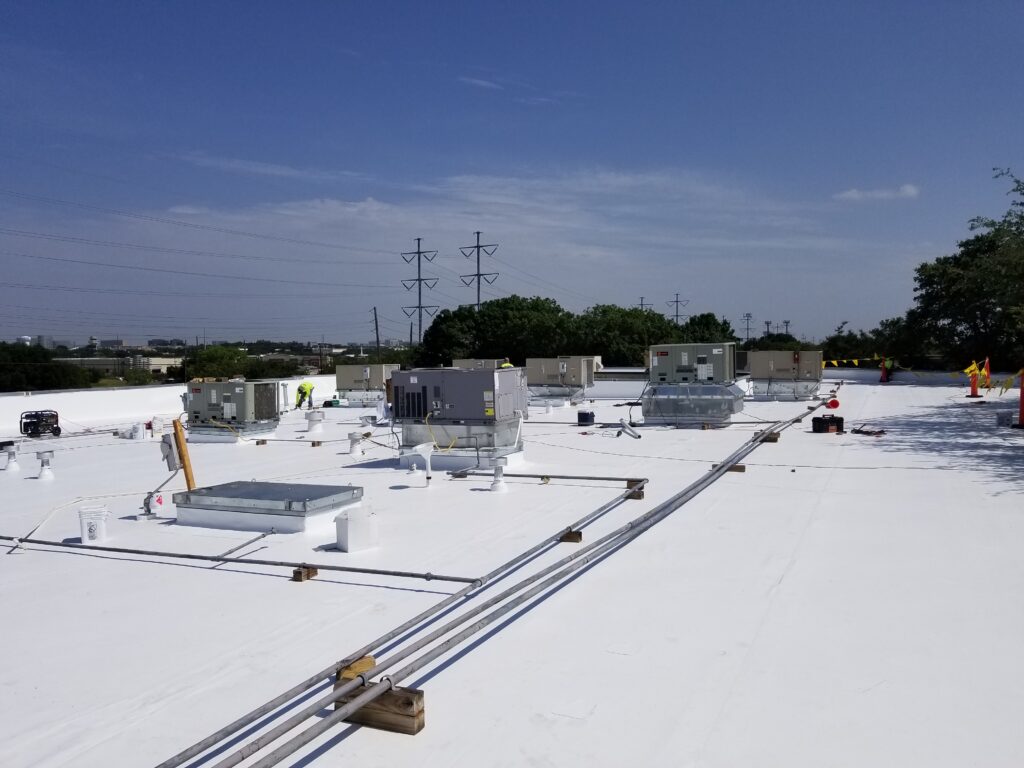
TPO Roof Systems.
TPO Roof Systems support in New Orleans, LA, with documented inspections, written scopes, and practical roof planning for commercial properties.
What this roof work solves
TPO Roof Systems in New Orleans should begin with a documented roof walk. The first job is to identify active water entry, drainage problems, membrane condition, edge details, rooftop equipment conflicts, and weather exposure before a price or schedule is discussed.
For commercial owners, the useful answer is rarely a one-line recommendation. The roof file should explain the work area, the reason for the scope, the access constraints, and the next maintenance decision.
How the scope is built
The scope is based on system selection, building use, roof age, visible defects, and the cost difference between immediate repair and longer-range planning. When repair is enough, the work stays focused. When replacement or recover planning is the responsible move, the reasoning is written plainly.
Each finished project should leave behind before-and-after photos, service notes, and follow-up items so the owner keeps a record for future inspections, budgeting, and vendor conversations.
TPO is the dominant commercial flat-roof membrane in the New Orleans market because it handles the subtropical heat, carries 20-year NDL warranty paths, and, when properly attached, holds the perimeter and corner zones that hurricane-force winds attack first. The difference between a TPO roof that survives Ida and one that doesn't is not the membrane grade: it's the attachment method and the detail work at the parapets.
TPO single-ply membrane covers the majority of the post-Katrina commercial construction across New Orleans, Metairie, Kenner, and the surrounding parishes. The white membrane fits the Gulf Coast climate: it reflects rooftop surface temperatures that can exceed 150°F on dark surfaces in July, it carries 20-year no-dollar-limit warranty paths from every major manufacturer, and the hot-air seam weld creates a monolithic waterproofing layer that outperforms lap adhesives in the high-humidity conditions New Orleans buildings face year-round.
What separates a TPO roof that holds through a Category 3 hurricane from one that peels at the perimeter during the first major storm is the attachment design, not the membrane color or thickness. Every TPO system we install in the New Orleans metro includes a wind-uplift design specific to the building's dimensions, risk category, exposure classification, and deck type: calculated against ASCE 7 hurricane-prone region requirements, not pulled from a generic manufacturer table. The design goes into the project closeout file so the next owner, insurer, or facility manager has the documentation that matters.
New Orleans's subtropical humidity, summer dew points routinely exceed 75°F from June through September, affects TPO installation in ways that contractors from drier markets often underestimate. Adhesive cure windows shrink, seam bond quality is sensitive to surface moisture, and the moisture-related insulation degradation that causes latent membrane failure happens faster here than in most other US commercial roofing markets. We adjust application schedules, cure timing, and substrate moisture checks to match the actual climate, not the manufacturer's temperate-climate default.
Full-Adhered vs Mechanically Attached for Hurricane-Prone Region Buildings
Fully adhered TPO systems are the standard specification for commercial buildings in New Orleans classified as Risk Category III or IV under ASCE 7: hospitals, schools, emergency operations facilities, high-occupancy assembly buildings, and government facilities. Full adhesion eliminates the fastener withdrawal risk that is the most documented uplift failure mode in Gulf Coast hurricane events. Post-Ida damage surveys in Jefferson Parish confirmed the pattern: mechanically attached perimeter zones separated before center-field membrane was affected, consistent with the pressure coefficient distribution ASCE 7 predicts for hurricane-prone-region corner and perimeter zones.
For buildings where mechanically attached TPO is appropriate, Risk Category II commercial buildings with verified Exposure B conditions and structural decks that support the required fastener density, we run the FM design software calculation and specify the fastener pattern in the project file. Buildings in the lakefront corridor north of Veterans Boulevard, the New Orleans East warehouse zone along Chef Menteur Highway, and any open-terrain commercial site along the elevated I-10 corridors carry Exposure C designations that increase corner and perimeter uplift requirements substantially. We do not apply a standard mechanically attached pattern across all buildings regardless of exposure: the calculation drives the specification.
60-mil vs 80-mil TPO for New Orleans Commercial Buildings
The standard specification for New Orleans commercial flat roofs is 60-mil TPO from a manufacturer with a credentialed applicator program and active regional field-rep support. At 60 mil, every major manufacturer, GAF EverGuard, Carlisle SynTec, Johns Manville, Sika Sarnafil, Firestone, carries a 20-year no-dollar-limit warranty on qualifying installations, and the membrane handles Gulf Coast UV and heat loads without accelerated degradation in current formulations.
80-mil TPO makes sense in specific conditions common to the New Orleans market: buildings with heavy rooftop mechanical equipment requiring frequent maintenance access, industrial facilities in the New Orleans East corridor where the rooftop traffic risk is elevated, and owners who want the extended warranty term some manufacturers offer on 80-mil. For Risk Category III and IV buildings on full-adhered specifications, the additional thickness also improves puncture resistance during installation and maintenance: a relevant consideration when the contractor is working in summer heat on a fully-adhered substrate where repositioning is not possible after adhesive sets.
20-Year NDL Warranty and Post-Storm Documentation
Every major TPO manufacturer offers a 20-year no-dollar-limit warranty on qualifying installations. NDL means the manufacturer pays to repair defects in manufacturing or installation during the warranty period: no labor cap, no material deductible. That matters in the New Orleans market not just for routine warranty claims but for the post-hurricane documentation that moves Louisiana Department of Insurance wind-damage claims forward. A building with a current NDL warranty document, a roof zone diagram, and closeout photos has a fundamentally different claim outcome than one with a stack of unverified repair receipts.
Qualifying for NDL requires installation by a manufacturer-credentialed contractor, adherence to published detail drawings at every flashing condition, a manufacturer's field inspection at closeout, and documented annual maintenance. we install GAF EverGuard, Carlisle SynTec, Johns Manville, Sika Sarnafil, and Versico. We deliver the NDL document, not a warranty application: at project closeout, along with the wind-uplift design documentation, the roof zone photo diagram, and the maintenance contract that keeps the warranty current through hurricane seasons.
Does TPO hold up in a New Orleans hurricane?
Questions to settle early
Where is the risk?
Locate leaks, wet-insulation indicators, open seams, weak flashing, and drainage restrictions across the roof.
What can wait?
Separate immediate work from maintenance items that can be tracked for the next service window.
What should be funded?
Build a practical recommendation for repair, coating, recover, or replacement planning.
Need help with TPO roof systems?
Send the building address, known roof age, access notes, and what changed. We will respond with the right next step.