
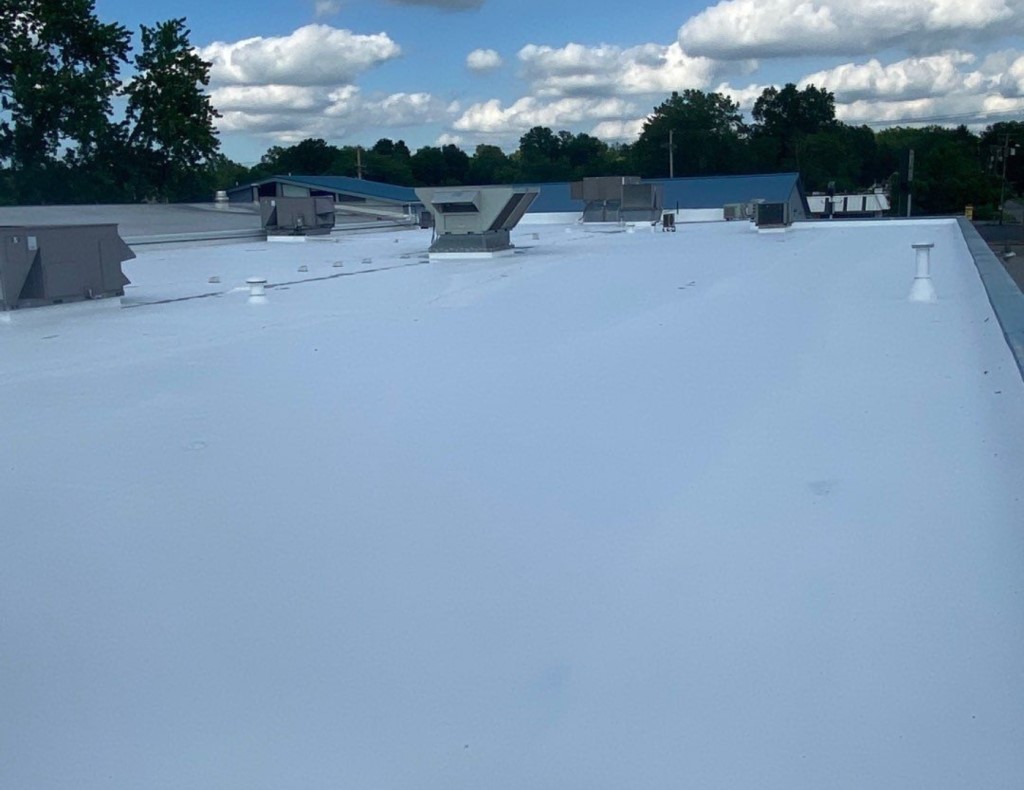
Single-Ply Roofing: Fully Adhered, Mechanically Attached, or Ballasted.
Single-Ply Roofing: Fully Adhered, Mechanically Attached, or Ballasted support in New Orleans, LA, with documented inspections, written scopes, and practical roof planning for commercial properties.
What this roof work solves
Single-Ply Roofing: Fully Adhered, Mechanically Attached, or Ballasted in New Orleans should begin with a documented roof walk. The first job is to identify active water entry, drainage problems, membrane condition, edge details, rooftop equipment conflicts, and weather exposure before a price or schedule is discussed.
For commercial owners, the useful answer is rarely a one-line recommendation. The roof file should explain the work area, the reason for the scope, the access constraints, and the next maintenance decision.
How the scope is built
The scope is based on service scope, building use, roof age, visible defects, and the cost difference between immediate repair and longer-range planning. When repair is enough, the work stays focused. When replacement or recover planning is the responsible move, the reasoning is written plainly.
Each finished project should leave behind before-and-after photos, service notes, and follow-up items so the owner keeps a record for future inspections, budgeting, and vendor conversations.
TPO, PVC, and EPDM single-ply membranes specified and installed against your New Orleans building's actual hurricane wind-uplift zone, risk category, substrate condition, and gulf-coast moisture management requirements, not a standard spec applied uniformly across every project.
Single-ply membranes dominate new commercial roofing across the New Orleans metro for the same reasons they dominate most large urban markets: fast installation, manufacturer- TPO, PVC, and EPDM collectively account for the large majority of new commercial membrane installations across Orleans and Jefferson parishes. What the product literature does not tell you is that the same TPO membrane in three different attachment configurations performs very differently on a New Orleans building in a Category 3 hurricane, and the attachment method decision is where single-ply specifications earn or lose their long-term value in this market.
Post-Ida damage surveys across Jefferson Parish documented a consistent pattern: mechanically attached TPO systems on open-terrain Exposure C buildings, lakefront commercial buildings along Veterans Boulevard, warehouse buildings in eastern New Orleans, experienced perimeter and corner failure where the original fastener density met the pre-2020 code minimum but not the actual pressure generated at building corners in 150 mph sustained wind conditions. Fully adhered systems on comparable buildings in the same storm track showed dramatically lower perimeter failure rates. That data point is now built into every single-ply specification we produce in this market.
We design the attachment method and membrane selection into the scope document: with the ASCE 7 wind-uplift calculation, the substrate assessment, the risk category determination, and the cost differential between attachment methods documented explicitly. Owners who understand why we are specifying fully adhered versus mechanically attached make better decisions about their buildings and are better positioned to evaluate alternative proposals that skip the engineering analysis.
Attachment Method Selection for New Orleans Buildings
Fully adhered: Standard specification for Risk Category III and IV buildings in New Orleans; hospitals, schools above 250-person occupancy, emergency operations facilities, and government buildings where the ASCE elevated perimeter and corner pressure coefficients beyond what mechanical attachment density can reliably deliver. Also specified on replacement projects where the existing deck cannot accept additional mechanical fastener penetrations and on buildings in open-terrain Exposure C zones: the eastern New Orleans warehouse corridor, the lakefront commercial strip in Metairie, where the actual wind pressure in a Gulf Coast storm event has been documented by post-storm surveys to exceed mechanically attached fastener design assumptions. Adhesive selection is system-specific and dew-point-sensitive: New Orleans's high ambient humidity requires application-window management that is more stringent than in drier markets.
Mechanically attached: Appropriate for standard urban Exposure B commercial buildings in the New Orleans CBD, Uptown, and Metairie corridors where the building height, dimensions, and exposure category support an FM-calculated fastener pattern that meets the post-Katrina Louisiana building code wind-uplift requirements. We run the FM design software calculation for every mechanically attached project: we do not apply a generic standard-table pattern without verifying the design pressure against the building's actual parameters. Perimeter and corner zone fastener density is always increased relative to field zone density, and that increased density is documented in the project closeout file.
Ballasted: Loose-laid membrane weighted with washed river stone ballast. Requires structural verification that the building deck can carry the ballast load: in New Orleans, many light-gauge steel deck buildings have limited surplus live-load capacity, and ballasted systems consume most of it. Ballasted systems are not specified for hurricane-prone-region commercial buildings because the ballast can become airborne debris in a major storm event. We rarely specify ballasted single-ply on New Orleans commercial work except on specific pre- and the structural deck has been verified for the load.
Membrane Selection: TPO, PVC, and EPDM in the New Orleans Market
TPO (thermoplastic polyolefin): Default specification for most New Orleans commercial buildings without chemical exhaust exposure concerns. Heat-weldable seams, standard white delivering SRI 78 to 104 for Louisiana energy code cool-roof compliance, 20-year NDL warranty paths at 60-mil and 80-mil. Most economical material cost of the three membrane types. Fully adhered TPO is the standard specification for Risk Category III and IV buildings in this market.
PVC (polyvinyl chloride): Specified for chemical exposure environments; restaurants and hospitality buildings on high-exhaust corridors, food processing, dry-cleaning tenants, and maritime-adjacent industrial facilities. 25-year NDL warranty available from Sika Sarnafil and Versico on qualifying configurations. The French Quarter and Magazine Street restaurant corridors are PVC territory on any building with significant kitchen exhaust loading.
EPDM (ethylene propylene diene monomer): Thermoset membrane with the longest proven track record in New Orleans institutional and medical applications. Cold-seamed with adhesive and tape, not heat-welded, which simplifies hot-work permit compliance for occupied medical buildings. Preferred for medical-office buildings in the Tulane-Gravier medical district and university campus buildings where chemical exhaust resistance and conservative specification standards favor the thermoset approach. 20-year NDL available at 60-mil.
New Orleans Climate and Gulf Coast Factors in Single-Ply System Design
Thermal cycling and humid climate: New Orleans roofs cycle from winter lows in the mid-20s Fahrenheit to peak summer surface temperatures exceeding 150°F on dark membranes, and the high ambient humidity means that moisture vapor pressure in the roof assembly is elevated year-round. Fully adhered systems must manage thermal movement through properly detailed expansion joints; buildings without expansion joints on fully adhered systems show membrane stress at parapet corners that accelerates to cracking under repeated seasonal cycling. We specify expansion joints at column lines and at 150-foot intervals on large fully adhered projects.
Questions to settle early
Where is the risk?
Locate leaks, wet-insulation indicators, open seams, weak flashing, and drainage restrictions across the roof.
What can wait?
Separate immediate work from maintenance items that can be tracked for the next service window.
What should be funded?
Build a practical recommendation for repair, coating, recover, or replacement planning.
Need help with single-ply roofing: fully adhered, mechanically attached, or ballasted?
Send the building address, known roof age, access notes, and what changed. We will respond with the right next step.