
Spray Polyurethane Foam Roof Systems.
Spray Polyurethane Foam Roof Systems support in New Orleans, LA, with documented inspections, written scopes, and practical roof planning for commercial properties.
What this roof work solves
Spray Polyurethane Foam Roof Systems in New Orleans should begin with a documented roof walk. The first job is to identify active water entry, drainage problems, membrane condition, edge details, rooftop equipment conflicts, and weather exposure before a price or schedule is discussed.
For commercial owners, the useful answer is rarely a one-line recommendation. The roof file should explain the work area, the reason for the scope, the access constraints, and the next maintenance decision.
How the scope is built
The scope is based on system selection, building use, roof age, visible defects, and the cost difference between immediate repair and longer-range planning. When repair is enough, the work stays focused. When replacement or recover planning is the responsible move, the reasoning is written plainly.
Each finished project should leave behind before-and-after photos, service notes, and follow-up items so the owner keeps a record for future inspections, budgeting, and vendor conversations.
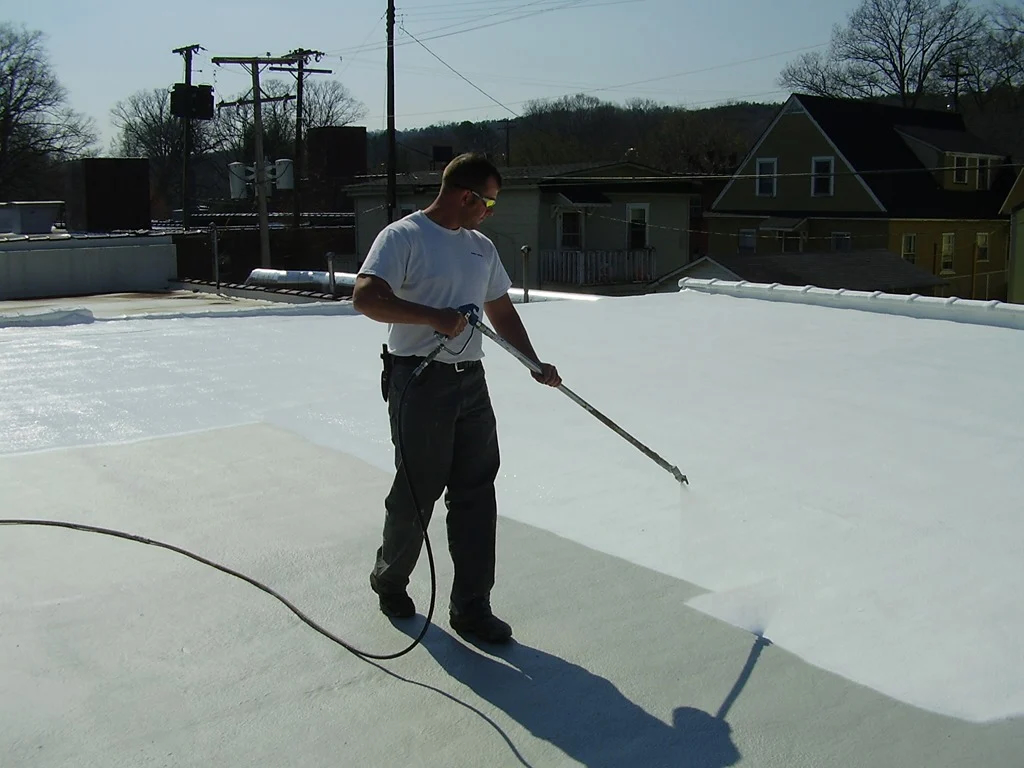
Spray polyurethane foam is a seamless, self-insulating recover system with genuine advantages for the right New Orleans building. The Gulf Coast climate, high annual rainfall, chronic summer humidity, and coastal wind patterns, narrows the qualifying application window more aggressively than in most US markets. We install SPF where the conditions and substrate genuinely support it, and we do not recommend it where they do not.
Spray polyurethane foam (SPF) roofing creates a seamless, closed-cell insulating surface by spraying a two-component polyurethane foam directly onto the existing roof substrate. The foam expands, adheres, and is then coated with an elastomeric protective coating, typically silicone at 20-to-25 mil DFT, that shields the foam from UV degradation and physical damage. The result is a monolithic roof surface with no seams, no penetration flashings in the traditional sense, and a continuous R-value stack across the entire field.
The appeal for New Orleans industrial and warehouse buildings is real. Large-footprint buildings in the New Orleans East warehouse corridor along Chef Menteur Highway, the industrial buildings along the Earhart Expressway in Jefferson Parish, and manufacturing facilities in the West Bank industrial zone often have complex roof geometry: multiple elevation changes, dense rooftop equipment, and drain patterns that would require extensive custom fabrication in a conventional single-ply recover. SPF's seamless application handles that complexity without producing the field seams that are the primary vulnerability on complex single-ply roofs.
What constrains SPF in New Orleans more than in most other markets is the climate. Spray polyurethane foam requires wind speeds below 12 mph during application: coastal wind patterns in the New Orleans area frequently exceed that threshold on days that otherwise appear suitable for roofing work. The substrate must be completely dry, and in New Orleans's summer humidity, achieving the substrate dryness that foam adhesion requires is a genuine scheduling challenge from June through October. We schedule SPF work in fall, winter, and early spring when humidity drops and wind patterns are most reliably below the application threshold.
Closed-Cell Foam Density and Performance in the Gulf Coast Climate
SPF roofing in New Orleans requires closed-cell polyurethane foam at minimum 2.5 pounds per cubic foot density. The closed-cell structure is what gives the foam its waterproofing function: open-cell foam absorbs moisture and fails as a roofing material in any climate, and in New Orleans's humidity it would fail immediately. We core-sample installed foam to verify density before the protective coating goes on: the warranty is conditioned on density meeting specification.
Thickness and R-value: one inch of 2.5-pcf closed-cell foam yields approximately R-6.5. For Louisiana's Climate Zone 2A energy code compliance on a commercial recover project, the SPF thickness calculation accounts for the existing insulation R-value beneath the foam layer. In practice, SPF applications on New Orleans commercial builds run 2-to-3 inches over qualified existing insulation. The foam also adds meaningful structural rigidity to the roof assembly: a property relevant for buildings that experienced minor structural compromise in Katrina or Ida and have slight deck irregularities that the foam bridges.
Wind Constraints and Application Scheduling in New Orleans
The 12-mph wind limit for SPF application is genuinely limiting in the New Orleans coastal environment. Coastal wind patterns driven by Gulf sea-breeze circulation regularly produce surface wind speeds above 12 mph during afternoon hours, even on days with no storm activity. Pre-dawn and early-morning application windows, the same early-start discipline we apply to high-temperature adhesive work in summer, are often the only viable spray windows on days that otherwise appear suitable for production.
The practical result is that SPF projects in New Orleans require longer production schedules than equivalent projects in inland markets, because not every production day will have a morning application window that meets the wind threshold. We build this into project schedules and communicate it to building owners before contract signing. SPF is not appropriate for projects with hard completion deadlines that cannot accommodate weather-window dependencies.
New Orleans Buildings Where SPF Makes Sense
The strongest SPF candidates in the New Orleans metro share a specific profile: large-footprint commercial or industrial buildings with complex roof geometry, existing insulation that is documented dry on core pulls, Exposure B wind classification (sheltered urban or suburban sites, not the lakefront or open-terrain corridors), and project timing that allows fall-through-spring scheduling. Buildings in the Mid-City and Metairie commercial corridors that
Buildings that do not fit SPF in New Orleans: any building in an open-terrain Exposure C zone along the lakefront or the New Orleans East industrial corridor (coastal wind patterns make the application window too narrow to be reliably productive), any building with documented moisture in more than 15% of insulation cores (a more conservative threshold than we apply in drier markets, because the chronic humidity environment means wet insulation under foam will not dry out and will cause adhesion failure), and any building on a coal-tar BUR substrate (coal tar is not a compatible foam adhesion surface).
Why don't more New Orleans commercial buildings use SPF roofing?
Questions to settle early
Where is the risk?
Locate leaks, wet-insulation indicators, open seams, weak flashing, and drainage restrictions across the roof.
What can wait?
Separate immediate work from maintenance items that can be tracked for the next service window.
What should be funded?
Build a practical recommendation for repair, coating, recover, or replacement planning.
Need help with spray polyurethane foam roof systems?
Send the building address, known roof age, access notes, and what changed. We will respond with the right next step.