
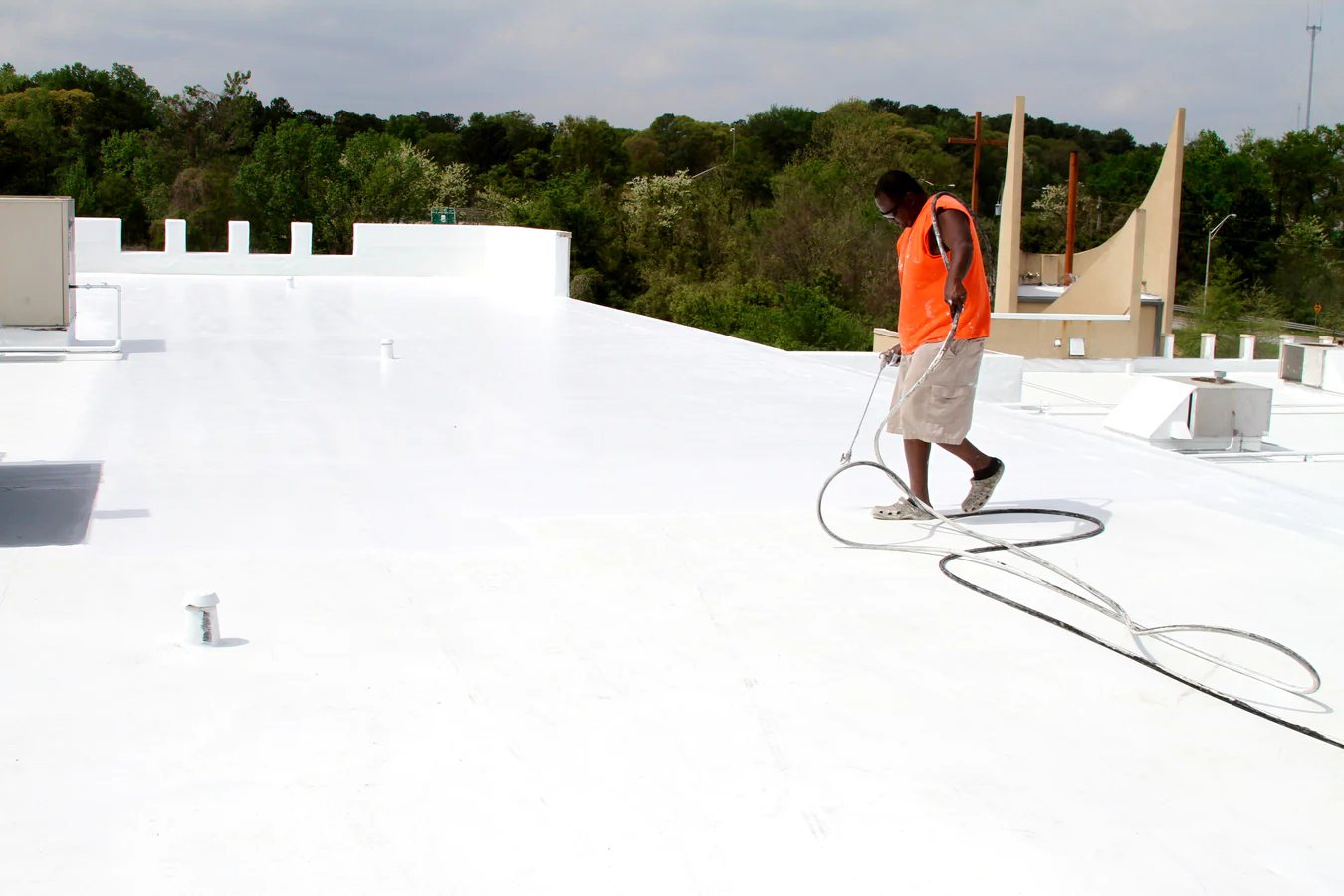
Silicone Roof Coating: Fluid-Applied Restoration.
Silicone Roof Coating: Fluid-Applied Restoration support in New Orleans, LA, with documented inspections, written scopes, and practical roof planning for commercial properties.
What this roof work solves
Silicone Roof Coating: Fluid-Applied Restoration in New Orleans should begin with a documented roof walk. The first job is to identify active water entry, drainage problems, membrane condition, edge details, rooftop equipment conflicts, and weather exposure before a price or schedule is discussed.
For commercial owners, the useful answer is rarely a one-line recommendation. The roof file should explain the work area, the reason for the scope, the access constraints, and the next maintenance decision.
How the scope is built
The scope is based on service scope, building use, roof age, visible defects, and the cost difference between immediate repair and longer-range planning. When repair is enough, the work stays focused. When replacement or recover planning is the responsible move, the reasoning is written plainly.
Each finished project should leave behind before-and-after photos, service notes, and follow-up items so the owner keeps a record for future inspections, budgeting, and vendor conversations.
Silicone fluid-applied roofing is one of the most cost-effective capital decisions available to New Orleans commercial building owners who have a qualifying existing membrane. We scope, prep, and apply silicone systems with 10, 15, and 20-year manufacturer warranty paths, and we tell you upfront when the substrate does not qualify and coating is not the defensible answer.
Silicone fluid-applied roofing restores an existing qualifying membrane by encapsulating it under a seamless, UV-stable silicone layer that carries a new manufacturer warranty at roughly 50-60% of full replacement cost. The category is particularly relevant to the New Orleans commercial market because a large share of the TPO and modified bitumen membranes installed during the post-Katrina reconstruction wave of 2006-2015 are now entering the age range where restoration is possible: roughly 10-20 years of service on an otherwise intact membrane with dry insulation.
We apply silicone coating systems from manufacturers including Tremco WJ, Versico, and Polyglass. We do not treat coating as the answer to every aging roof inquiry. A silicone application on a substrate with wet insulation or open membrane defects will fail its warranty inspection and be voided by the manufacturer. Our first step on any coating project is a substrate assessment that is honest about what the roof will and will not support: if the insulation is saturated or the membrane is compromised, we say so and scope the correct path instead.
The three standard warranty paths, 10, 15, and 20 years, are determined by application mil thickness, the number of passes, the substrate type, and manufacturer-specific system design requirements. In the New Orleans climate, the performance gap between a minimum-thickness 10-year application and a fabric-reinforced 20-year system is more pronounced than in drier markets, because the annual rainfall volume and tropical storm exposure put more sustained stress on the coating's adhesion and elongation capacity.
When Silicone Coating Is the Right Scope in New Orleans
A roof qualifies for silicone restoration when three conditions are met: the insulation is dry at the majority of core-pull locations, the existing membrane is intact and adhered without open seams or field delamination, and the deck has no structural compromise under any core location. Buildings that meet all three criteria can typically avoid the cost and disruption of full tear-off and extend the roof's warranty life at a fraction of replacement cost: a significant advantage for property owners managing multiple Orleans and Jefferson Parish assets simultaneously.
The most common qualifying substrates on New Orleans commercial buildings are: post-Katrina TPO systems (mechanically attached or fully adhered) that are 10-20 years old and retained good membrane integrity despite the storm seasons they have been through; modified bitumen cap sheet in good surface condition; and spray polyurethane foam that has reached its scheduled re-coat interval. Older BUR surfaces can qualify with the correct primer and base coat, but in this market we apply more conservative wet-core thresholds to BUR assessments because of the elevated baseline moisture risk.
The post-Katrina construction wave timing creates a qualification window opportunity in the current market. Many commercial buildings in Mid-City, Gentilly, Lakeview, and the lakefront corridor that received new membranes between 2007 and 2014 are now 10-18 years into their membrane life: qualifying territory for a restoration system on the buildings where the membrane held up through the subsequent storm seasons. A single inspection visit can determine where a specific building sits in that window.
Substrate Prep in New Orleans's Humid Subtropical Climate
Silicone coating adhesion and long-term performance are entirely dependent on substrate preparation, and the New Orleans climate creates substrate prep challenges that are more demanding than most inland markets face. Standard prep sequence: pressure washing at 3,500-4,000 PSI for field areas, lower pressure at seams and flashings; full inspection and documentation of any open seams, failed flashings, or wet areas requiring repair before coating; targeted repair of all deficiencies; and manufacturer-specified primer application on substrates that require it.
New Orleans dew-point conditions are the most significant application variable on any coating project in this market. From June through September, dew points regularly exceed 75°F: even on clear days. Silicone applied to a surface that is below the dew point or still retaining moisture from a prior rain event will not achieve manufacturer-specified adhesion. We check ambient temperature, dew point, and surface temperature with a calibrated gauge before every application session and halt application when conditions fall outside the manufacturer's written application window.
The window between washing and coating is tighter in New Orleans than in drier markets. A washed membrane left exposed for 48 hours in July humidity will develop surface contamination from atmospheric moisture and biological growth that compromises adhesion. We schedule coating passes immediately after the prep sequence rather than staging prep and coating as separate mobilization events. Application rate is also adjusted to wet-mil gauge readings every 1,000 sq ft: silicone cannot be added after cure, so mil verification during application is the quality control that makes the warranty inspection pass.
Ten-year warranty systems apply a minimum 20-wet-mil dry-film thickness in two passes. This is the entry warranty path: adequate for buildings where the owner's planning horizon is 10-15 years and the primary goal is to defer replacement cost while maintaining a warranted watertight system. In the New Orleans market, a 10-year system without fabric reinforcement at flashings and seams carries elevated risk at those detail locations given the storm-season exposure: we are more likely to recommend the 15-year path on buildings with significant parapet lengths or complex penetration counts.
Fifteen-year systems apply 25-30 dry-mil in two or three passes and include a reinforcing fabric embedded in the base coat at all flashings, seams, and parapet transitions. The fabric reinforcement converts the coating at those details from a field membrane into a warranted flashing assembly, and in this market's hurricane exposure, those detail locations are exactly where the system's performance is tested first. The fabric detail adds real labor cost but meaningfully changes what the warranty covers and how it holds up under storm-season conditions.
Questions to settle early
Where is the risk?
Locate leaks, wet-insulation indicators, open seams, weak flashing, and drainage restrictions across the roof.
What can wait?
Separate immediate work from maintenance items that can be tracked for the next service window.
What should be funded?
Build a practical recommendation for repair, coating, recover, or replacement planning.
Need help with silicone roof coating: fluid-applied restoration?
Send the building address, known roof age, access notes, and what changed. We will respond with the right next step.