
EPDM Roofing: Installation and Replacement.
EPDM Roofing: Installation and Replacement support in New Orleans, LA, with documented inspections, written scopes, and practical roof planning for commercial properties.
What this roof work solves
EPDM Roofing: Installation and Replacement in New Orleans should begin with a documented roof walk. The first job is to identify active water entry, drainage problems, membrane condition, edge details, rooftop equipment conflicts, and weather exposure before a price or schedule is discussed.
For commercial owners, the useful answer is rarely a one-line recommendation. The roof file should explain the work area, the reason for the scope, the access constraints, and the next maintenance decision.
How the scope is built
The scope is based on service scope, building use, roof age, visible defects, and the cost difference between immediate repair and longer-range planning. When repair is enough, the work stays focused. When replacement or recover planning is the responsible move, the reasoning is written plainly.
Each finished project should leave behind before-and-after photos, service notes, and follow-up items so the owner keeps a record for future inspections, budgeting, and vendor conversations.
60-mil EPDM on New Orleans commercial and institutional buildings: fully adhered and mechanically attached configurations, specified against ASCE 7 hurricane wind-uplift zone requirements and the subtropical moisture management demands of the gulf-coast climate.
EPDM (ethylene propylene diene monomer) has a long track record on New Orleans commercial buildings, particularly in institutional and medical-office applications where conservative specification standards and chemical exhaust resistance have kept EPDM competitive with newer single-ply options. The pre-Katrina commercial inventory across Orleans Parish includes a significant number of 45-mil EPDM installations from the 1980s and 1990s: systems that have been through multiple major storm events and are now well past their design life. That inventory represents an active replacement cycle across the metro.
The New Orleans climate presents specific challenges for EPDM performance that differ from temperate market conditions. High annual humidity accelerates adhesive seam bond degradation on older mechanically attached systems: the lap adhesive on pre-2005 EPDM installations has been subject to 20-plus years of subtropical heat and moisture cycling that is more aggressive than the bond degradation modeled in temperate market life-cycle tables. Perimeter and corner zone performance on mechanically attached EPDM is also a critical factor in a hurricane-prone region market: fastener patterns designed for standard Exposure B conditions may be inadequate for the open-terrain Exposure C corridors that characterize much of eastern New Orleans and the lakefront zones in Metairie.
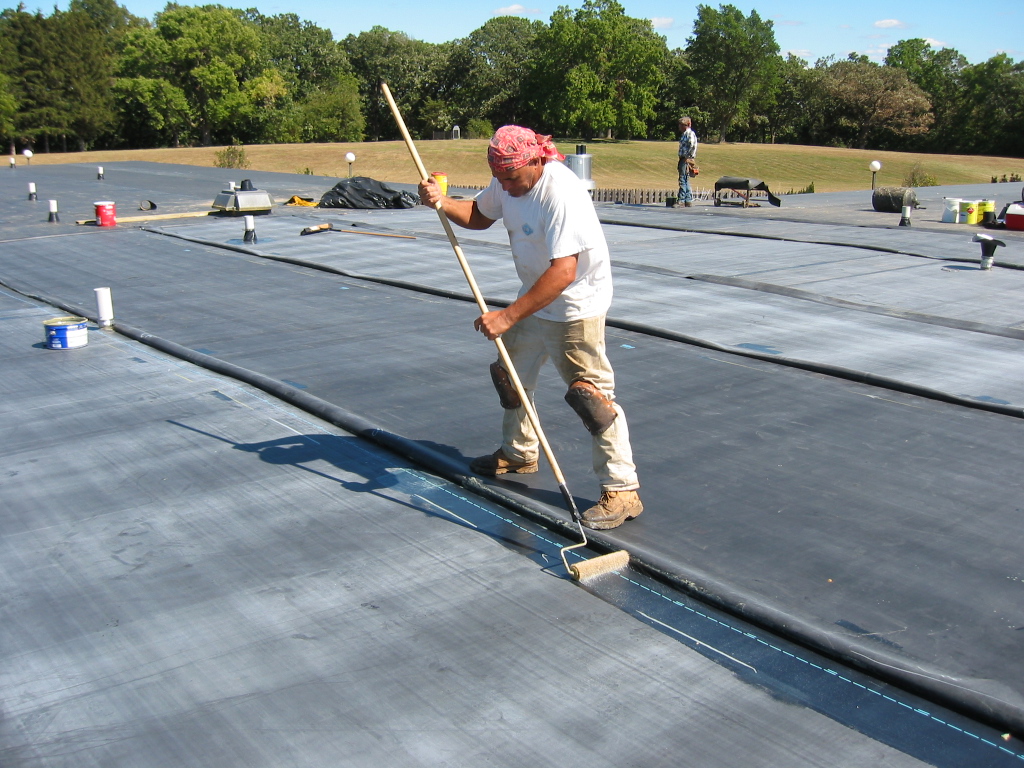
We install 60-mil EPDM in fully adhered and mechanically attached configurations on new construction, replacement, and recover projects across Orleans and Jefferson parishes. Fully adhered specification is standard for Risk Category III and IV buildings and for replacement projects where the ASCE 7 wind-uplift design cannot be met with mechanical attachment density alone.
60-mil EPDM Specifications and Attachment Methods
60-mil is the current commercial-grade standard for EPDM installations. 45-mil systems, common in the pre-Katrina New Orleans inventory, are no longer specified for new commercial work by any major manufacturer. The additional membrane thickness provides meaningful improvement in puncture resistance, seam durability, and longevity in New Orleans's high-moisture environment. Most 60-mil EPDM installations qualify for 20-year manufacturer NDL warranties.
Mechanically attached EPDM: Membrane fastened with screws and plates through seam laps into the insulation and deck. The fastener pattern is designed against the building's ASCE 7 wind-uplift zone, exposure category, and risk category. For New Orleans commercial buildings in standard urban exposure, Uptown commercial buildings along Magazine Street, CBD mid-rise office buildings, standard field-zone patterns with reinforced perimeter and corner density are appropriate. For buildings in open-terrain Exposure C, the eastern New Orleans warehouse corridor along Chef Menteur Highway, lakefront commercial buildings in Metairie along Veterans Boulevard near Lake Pontchartrain, we run the FM design calculation and document the pattern specifically for those pressure coefficients.
Fully adhered EPDM: Membrane bonded to cover board or insulation surface with a contact adhesive applied to both surfaces. Required for Risk Category III and IV buildings where the wind-uplift design exceeds mechanical attachment capacity, and preferred for replacement projects where the building's existing deck cannot accept additional fastener penetrations. Fully adhered systems eliminate the fastener withdrawal risk that post-Ida damage surveys identified as a primary failure mode in perimeter zones across Jefferson Parish. Installation requires careful adhesive application-window management in New Orleans's humidity: contact cement applied in dew-point-adjacent conditions performs below specification and produces early bond failure.
End-of-Life EPDM Replacement on the Pre-Katrina Commercial Inventory
The pre-Katrina EPDM inventory across Orleans Parish shares predictable failure characteristics after 25 to 35 years of subtropical service: lap adhesive that has lost bond across significant seam lengths, surface checking (fine membrane cracking) that has progressed from cosmetic to functional water pathways on 45-mil systems, and parapet base flashing assemblies detailed to pre-2005 code standards that have not been upgraded to post-Katrina wind-uplift requirements. These are replacement projects, not repair candidates.
Our typical scope on pre-Katrina EPDM replacement: full tear-off, moisture survey on the existing insulation with cores at representative locations, replacement of saturated insulation sections with new polyiso, installation of new 60-mil EPDM or TPO (based on owner preference and building use), wind-uplift design calculation and documentation, and manufacturer warranty closeout. We tear off and dry-in in sections to keep the building weathertight throughout production: during hurricane season, no section stays open overnight when tropical development is active in the Gulf.
Some property owners choose TPO rather than new EPDM for the replacement: TPO's heat-welded seams install somewhat faster than EPDM adhesive seaming, and standard white TPO provides cool-roof reflectivity compliance for Climate Zone 2A's IECC energy code. EPDM retains advantages in chemical-exhaust environments and in applications where the conservative track record of a thermoset membrane carries institutional weight. Both are valid choices: the decision depends on the building's use, maintenance history, and the owner's capital priorities.
EPDM in New Orleans Medical and Institutional Settings
EPDM is frequently specified on medical-office buildings in the Tulane-Gravier medical district and university campus buildings across Uptown because of its documented tolerance for the chemical exhaust profiles common in healthcare environments: sterilant agents, solvent fume hood discharge, and HVAC condensate chemistry from large chiller systems. Modern TPO formulations have improved chemical resistance relative to early-generation products, but EPDM remains the conservative default for facility managers who have seen early TPO failures from chemical exhaust exposure.
Questions to settle early
Where is the risk?
Locate leaks, wet-insulation indicators, open seams, weak flashing, and drainage restrictions across the roof.
What can wait?
Separate immediate work from maintenance items that can be tracked for the next service window.
What should be funded?
Build a practical recommendation for repair, coating, recover, or replacement planning.
Need help with EPDM roofing: installation and replacement?
Send the building address, known roof age, access notes, and what changed. We will respond with the right next step.